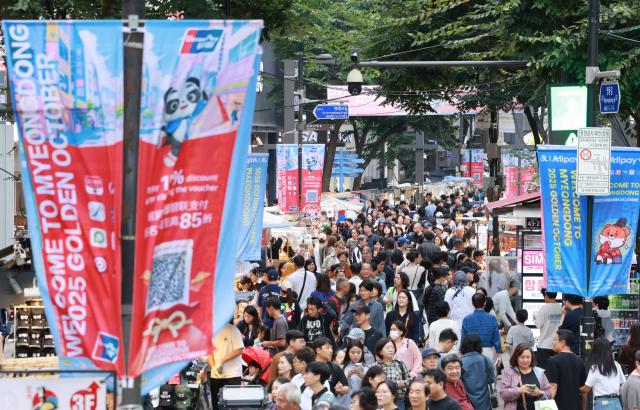
 Myeongdong in Seoul/ Yonhap
SEOUL, December 01 (AJP) - South Korea’s hotel scene is in the midst of a renaissance, energized by a surge of overseas travelers who are filling rooms, lifting revenues, and reshaping the country’s hospitality landscape.
At the center of this revival is the return of Chinese tourists — once South Korea’s largest visitor group — whose comeback is accelerating faster than many in the industry anticipated.
More than 14 million foreign tourists arrived in the first nine months of the year, a 16 percent jump, according to the Korea Tourism Organization. Nearly four in ten were from China, where renewed visa-free group travel and a wave of Korean pop-culture enthusiasm, particularly among Gen Z, are fueling demand. Officials expect Chinese arrivals to climb to 6.6 million next year, inching closer to pre-THAAD levels.
Inside South Korea’s hotels, the effects are unmistakable. Luxury properties have nearly regained their pre-pandemic occupancy rates, and average daily room prices have climbed to an all-time high of 306,000 won. Investors are also taking notice: hotel transaction volumes jumped 20 percent last year to 2.16 trillion won, signaling renewed confidence in the sector.
Glad Hotels, a brand under DL Group, has emerged as one of the clearest winners. By tailoring its marketing to young Chinese and female travelers in their 20s and 30s, the chain posted record quarterly results — 27.5 billion won in sales and 9.4 billion won in operating profit. Its Mapo location, set amid bustling cafés and cultural spots, has become a favorite backdrop for visiting Gen Z tourists documenting their trips on social media.
Industry executives say prime locations such as Yeouido, Gangnam Coex Center, and Mapo have become “strategic assets,” attracting international tourists and younger guests who are willing to pay premium rates. Analysts believe the tailwinds will last for years.
“South Korea is benefiting from a structural rise in travel demand,” said Hana Securities researcher Lee Ki-hoon. “A limited hotel supply pipeline, combined with the global spread of K-content, will support record earnings at least through 2027.” He added that any further relaxation of visa rules would provide another lift, particularly from China.
* This article, published by Aju Business Daily, was translated by AI and edited by AJP.
Kang Sang-heon 기자 ksh@ajunews.com

![[포토] 예지원, 전통과 현대가 공존한 화보 공개](https://image.ajunews.com/content/image/2025/10/09/20251009182431778689.jpg)
![블랙핑크 제니, 최강매력! [포토]](https://file.sportsseoul.com/news/cms/2025/09/05/news-p.v1.20250905.ed1b2684d2d64e359332640e38dac841_P1.jpg)
![[포토] 발표하는 김정수 삼양식품 부회장](https://image.ajunews.com/content/image/2025/11/03/20251103114206916880.jpg)
![[포토]두산 안재석, 관중석 들썩이게 한 끝내기 2루타](https://file.sportsseoul.com/news/cms/2025/08/28/news-p.v1.20250828.1a1c4d0be7434f6b80434dced03368c0_P1.jpg)
![블랙핑크 제니, 매력이 넘쳐! [포토]](https://file.sportsseoul.com/news/cms/2025/09/05/news-p.v1.20250905.c5a971a36b494f9fb24aea8cccf6816f_P1.jpg)
![[포토] '삼양1963 런칭 쇼케이스'](https://image.ajunews.com/content/image/2025/11/03/20251103114008977281.jpg)
![[포토] 박지현 '순백의 여신'](http://www.segye.com/content/image/2025/09/05/20250905507414.jpg)
![[포토] 키스오브라이프 하늘 '완벽한 미모'](http://www.segye.com/content/image/2025/09/05/20250905504457.jpg)
![[포토] 아이들 소연 '매력적인 눈빛'](http://www.segye.com/content/image/2025/09/12/20250912508492.jpg)
![[포토] 국회 예결위 참석하는 김민석 총리](https://cphoto.asiae.co.kr/listimg_link.php?idx=2&no=2025110710410898931_1762479667.jpg)
![[포토] 박지현 '아름다운 미모'](http://www.segye.com/content/image/2025/11/19/20251119519369.jpg)
![[포토] 김고은 '단발 여신'](http://www.segye.com/content/image/2025/09/05/20250905507236.jpg)
![[작아진 호랑이③] 9위 추락 시 KBO 최초…승리의 여신 떠난 자리, KIA를 덮친 '우승 징크스'](http://www.sportsworldi.com/content/image/2025/09/04/20250904518238.jpg)
![[포토]첫 타석부터 안타 치는 LG 문성주](https://file.sportsseoul.com/news/cms/2025/09/02/news-p.v1.20250902.8962276ed11c468c90062ee85072fa38_P1.jpg)
![[포토] 키스오브라이프 쥴리 '단발 여신'](http://www.segye.com/content/image/2025/09/05/20250905504358.jpg)
![[포토]끝내기 안타의 기쁨을 만끽하는 두산 안재석](https://file.sportsseoul.com/news/cms/2025/08/28/news-p.v1.20250828.0df70b9fa54d4610990f1b34c08c6a63_P1.jpg)
![[포토] 알리익스프레스, 광군제 앞두고 팝업스토어 오픈](https://cphoto.asiae.co.kr/listimg_link.php?idx=2&no=2025110714160199219_1762492560.jpg)
![[포토] 한샘, '플래그십 부산센텀' 리뉴얼 오픈](https://image.ajunews.com/content/image/2025/10/31/20251031142544910604.jpg)
![[포토] 언론 현업단체, "시민피해구제 확대 찬성, 권력감시 약화 반대"](https://image.ajunews.com/content/image/2025/09/05/20250905123135571578.jpg)
![[포토] 김고은 '상연 생각에 눈물이 흘러'](http://www.segye.com/content/image/2025/09/05/20250905507613.jpg)
![[포토]두산 안재석, 연장 승부를 끝내는 2루타](https://file.sportsseoul.com/news/cms/2025/08/28/news-p.v1.20250828.b12bc405ed464d9db2c3d324c2491a1d_P1.jpg)
![[포토] 아홉 '신나는 컴백 무대'](http://www.segye.com/content/image/2025/11/04/20251104514134.jpg)

![[포토] TXT 범규 '반가운 손인사'](http://www.segye.com/content/image/2025/11/05/20251105518398.jpg)