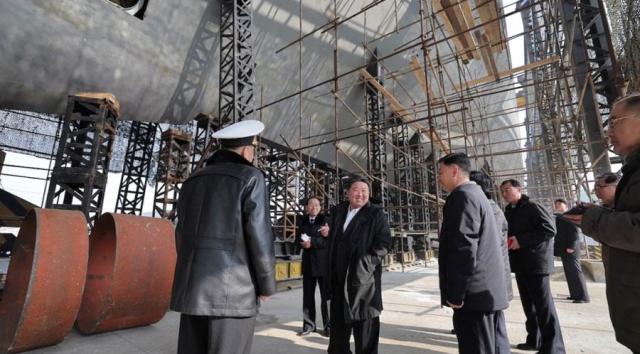
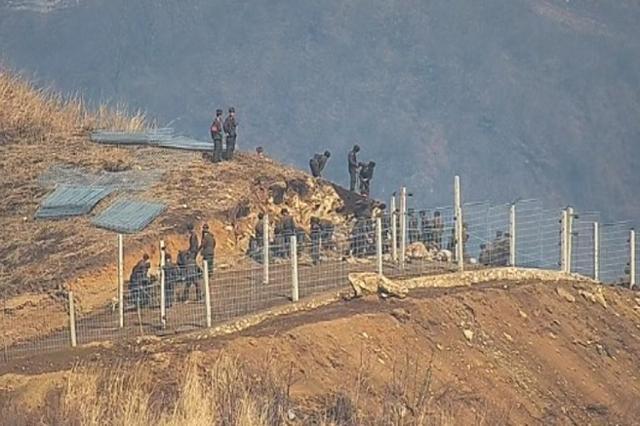
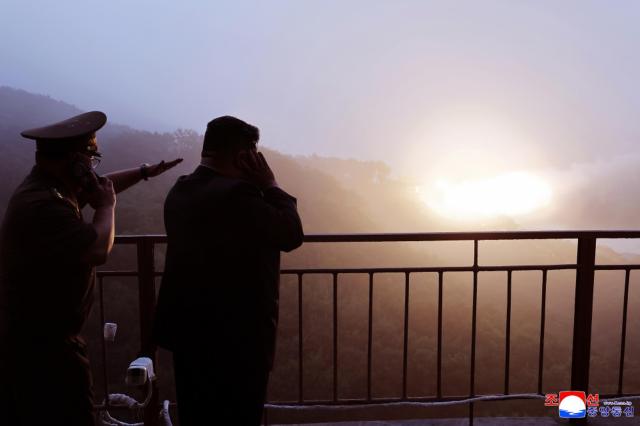
 North Korea conducts ground test of carbon-fiber solid-fuel engine on Sept. 8, with leader Kim Jong Un in attendance in this photo released by the official [North] Korean Central News Agency the following day. YonhapSEOUL, September 9 (AJP) - North Korea tested a new high-thrust solid-fuel engine for intercontinental ballistic missiles (ICBMs), state media reported on Tuesday.
 According to the state-run [North] Korean Central News Agency (KCNA), the reclusive country "conducted another ground jet test of a high-thrust solid-fuel engine using composite carbon fiber material," with its leader Kim Jong-un inspecting the test.
KCNA said it was the "ninth ground jet test" of its kind and the "last one in the development process," capable of producing a maximum thrust of 1,971 kilonewtons, which is roughly equivalent to lifting 200 tons of weight.
Kim praised the test as a “success assuming the most strategic nature in the recent modernization of defense technology," adding that it signals a "significant change in expanding and strengthening the nuclear strategic forces" of North Korea.
Tuesday's test came about a week after KCNA hinted at a "new-type solid-fuel engine" intended for its Hwasong series of ICBMs, which it claims could reach the U.S. mainland.
Earlier this month, the state media suggested the new solid motor is the "new-type solid-fuel engine" will be used in "the next-generation ICBM" Hwasong-20 as well as in the ICBM Hwasong-19, which it claimed would be capable of reaching the U.S. mainland.
Traditional solid-fuel motors use hardened propellant that enables rapid launch but rely on heavy metal shells that limit performance. A carbon-fiber composite shell makes the engine lighter, enables more fuel to be carried, and generate greater thrust, a key upgrade for long-range ICBMs.
Shin Seung-ki, a research fellow at the Korea Institute for Defense Analyses (KIDA), told Aju Press that Pyongyang has already reached sufficient range with its ICBMs and is now working to increase thrust to carry more warheads. "They are aiming to carry more warheads so that the U.S. will feel more threatened." With a 200-ton thrust level, he estimated the missile could carry five to six warheads, compared to about 10 on U.S. ICBMs. "From Washington's perspective, this inevitably poses a greater threat," he added.
North Korea has already unveiled several ICBMs capable of reaching the U.S. mainland, including the Hwasong-15 in 2017, the larger Hwasong-17 in 2022 and the Hwasong-19 in 2024, which experts saw as a precursor to the Hwasong-20.
Cheon Soram 기자 cheons@ajupress.com
![[포토] 예지원, 전통과 현대가 공존한 화보 공개](https://image.ajunews.com/content/image/2025/10/09/20251009182431778689.jpg)
![블랙핑크 제니, 최강매력! [포토]](https://file.sportsseoul.com/news/cms/2025/09/05/news-p.v1.20250905.ed1b2684d2d64e359332640e38dac841_P1.jpg)
![[포토] 발표하는 김정수 삼양식품 부회장](https://image.ajunews.com/content/image/2025/11/03/20251103114206916880.jpg)
![[포토]두산 안재석, 관중석 들썩이게 한 끝내기 2루타](https://file.sportsseoul.com/news/cms/2025/08/28/news-p.v1.20250828.1a1c4d0be7434f6b80434dced03368c0_P1.jpg)
![블랙핑크 제니, 매력이 넘쳐! [포토]](https://file.sportsseoul.com/news/cms/2025/09/05/news-p.v1.20250905.c5a971a36b494f9fb24aea8cccf6816f_P1.jpg)
![[포토] '삼양1963 런칭 쇼케이스'](https://image.ajunews.com/content/image/2025/11/03/20251103114008977281.jpg)
![[포토] 박지현 '순백의 여신'](http://www.segye.com/content/image/2025/09/05/20250905507414.jpg)
![[포토] 키스오브라이프 하늘 '완벽한 미모'](http://www.segye.com/content/image/2025/09/05/20250905504457.jpg)
![[포토] 아이들 소연 '매력적인 눈빛'](http://www.segye.com/content/image/2025/09/12/20250912508492.jpg)
![[포토] 국회 예결위 참석하는 김민석 총리](https://cphoto.asiae.co.kr/listimg_link.php?idx=2&no=2025110710410898931_1762479667.jpg)
![[포토] 박지현 '아름다운 미모'](http://www.segye.com/content/image/2025/11/19/20251119519369.jpg)
![[포토] 김고은 '단발 여신'](http://www.segye.com/content/image/2025/09/05/20250905507236.jpg)
![[작아진 호랑이③] 9위 추락 시 KBO 최초…승리의 여신 떠난 자리, KIA를 덮친 '우승 징크스'](http://www.sportsworldi.com/content/image/2025/09/04/20250904518238.jpg)
![[포토]첫 타석부터 안타 치는 LG 문성주](https://file.sportsseoul.com/news/cms/2025/09/02/news-p.v1.20250902.8962276ed11c468c90062ee85072fa38_P1.jpg)

![[포토] 키스오브라이프 쥴리 '단발 여신'](http://www.segye.com/content/image/2025/09/05/20250905504358.jpg)
![[포토]끝내기 안타의 기쁨을 만끽하는 두산 안재석](https://file.sportsseoul.com/news/cms/2025/08/28/news-p.v1.20250828.0df70b9fa54d4610990f1b34c08c6a63_P1.jpg)
![[포토] 알리익스프레스, 광군제 앞두고 팝업스토어 오픈](https://cphoto.asiae.co.kr/listimg_link.php?idx=2&no=2025110714160199219_1762492560.jpg)
![[포토] 한샘, '플래그십 부산센텀' 리뉴얼 오픈](https://image.ajunews.com/content/image/2025/10/31/20251031142544910604.jpg)
![[포토] 언론 현업단체, "시민피해구제 확대 찬성, 권력감시 약화 반대"](https://image.ajunews.com/content/image/2025/09/05/20250905123135571578.jpg)
![[포토] 김고은 '상연 생각에 눈물이 흘러'](http://www.segye.com/content/image/2025/09/05/20250905507613.jpg)
![[포토]두산 안재석, 연장 승부를 끝내는 2루타](https://file.sportsseoul.com/news/cms/2025/08/28/news-p.v1.20250828.b12bc405ed464d9db2c3d324c2491a1d_P1.jpg)
![[포토] 아홉 '신나는 컴백 무대'](http://www.segye.com/content/image/2025/11/04/20251104514134.jpg)

![[포토] TXT 범규 '반가운 손인사'](http://www.segye.com/content/image/2025/11/05/20251105518398.jpg)