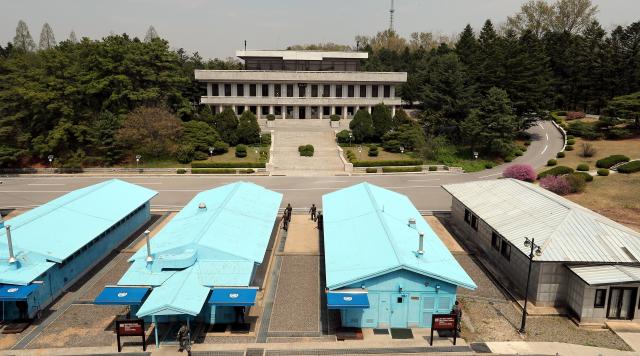
 A view from Freedom House on the southern side of the border looking toward North Korea. The Neutral Nations Supervisory Commission meeting hall stands in the foreground, with North Korea's Panmungak visible in the background. Yonhap
 SEOUL, December 18 (AJP) - Located within the Joint Security Area (JSA), Panmunjeom is the historic site where the Korean War armistice agreement was signed in 1953.
Today, it remains a unique zone jointly managed by North and South Korea, partitioned by the Military Demarcation Line. While the area currently sits in silence due to strained inter-Korean relations and a total freeze in diplomacy, it remains the primary stage for global attention whenever dialogue resumes on the peninsula.
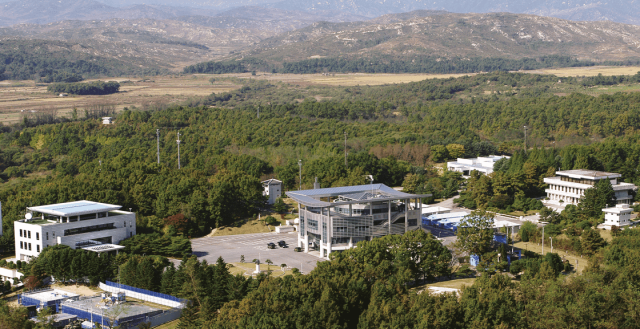 A view of Panmunjeom/ Courtesy of the Ministry of Unification
 Once an anonymous hamlet consisting of only a few thatched-roof houses, Panmunjeom rose to international prominence when it became the venue for armistice negotiations on Oct. 25, 1951.
After nearly two years of talks, the armistice agreement was finally signed here on July 27, 1953. The site also facilitated the exchange of prisoners of war between August and September of that year.
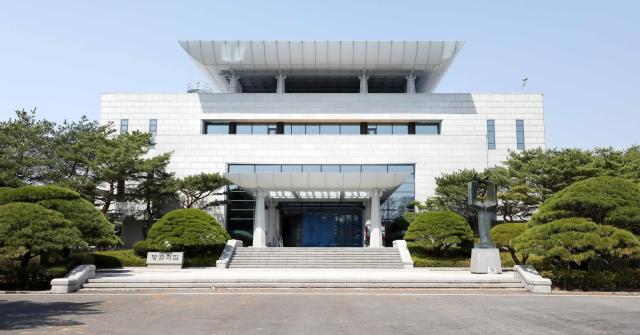
The JSA features seven functional buildings situated directly atop the MDL, including those used by the Neutral Nations Supervisory Commission (NNSC). Facilities on the southern side include Freedom House and Peace House, while the northern side is home to Panmungak and Panmungwan (formerly known as Tongilgak).
Public access to the site has been restricted for over two years. Following the unauthorized crossing of a U.S. soldier into North Korea on July 18, 2023, general tours of Panmunjeom remain indefinitely suspended as of December 2025.
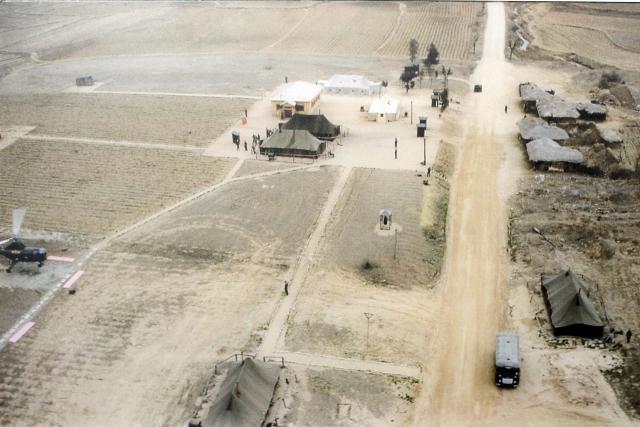 A view of Panmunjeom during the Korean War armistice negotiations in 1952/ Courtesy of the National Museum of Korean Contemporary History
 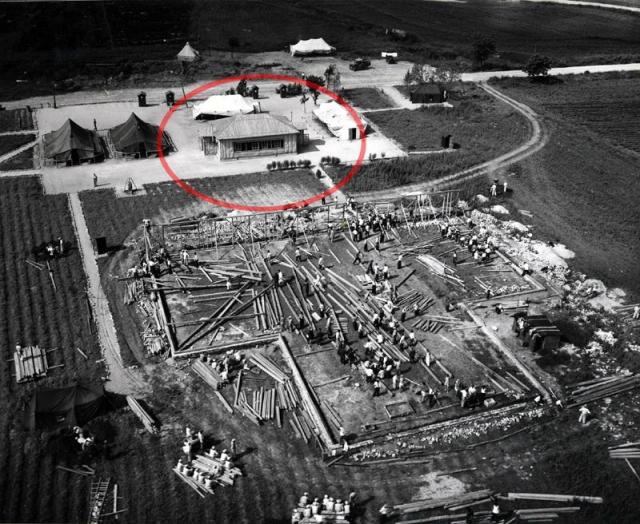 Workers construct a new venue for the signing of the Korean Armistice Agreement in June 1953. The signing hall was built on a much larger scale than the original negotiation room (indicated by the circle). Courtesy of the National Institute of Korean History
 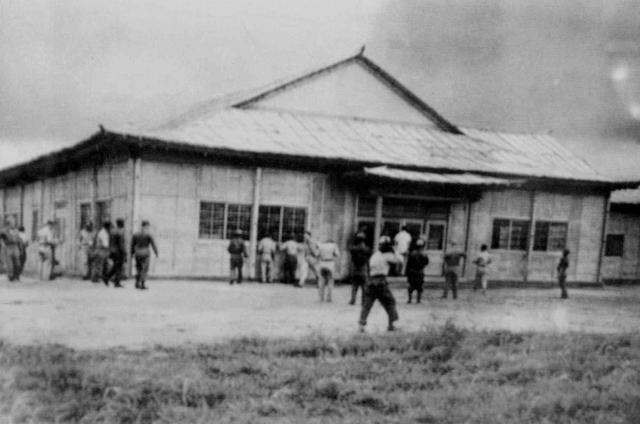 The site of the 1953 armistice signing ceremony at Panmunjeom/ Courtesy of the U.S. Forces Korea
 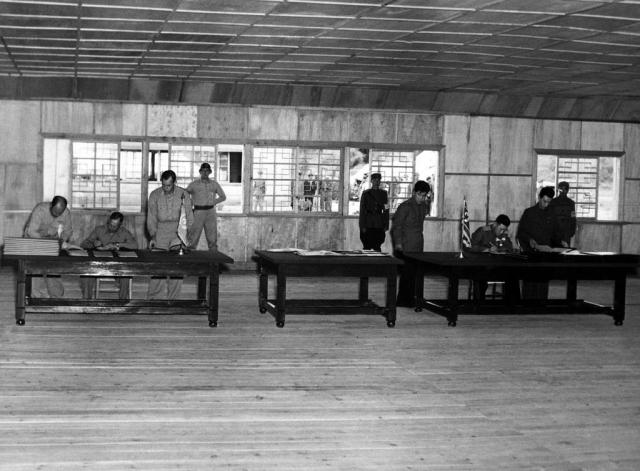 The signing of the Korean War armistice agreement/ Courtesy of the U.S. Forces Korea
 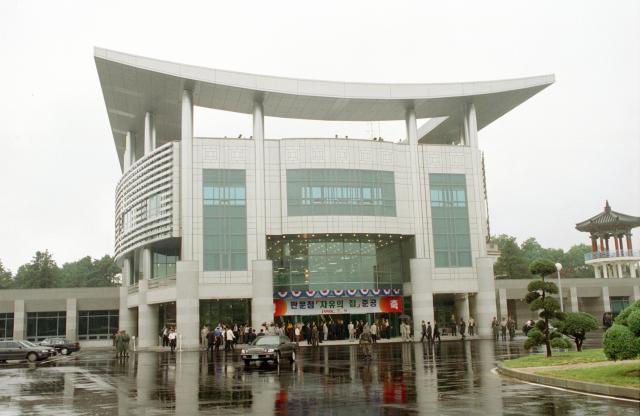 Freedom House/ Yonhap
  Peace House/ Yonhap
 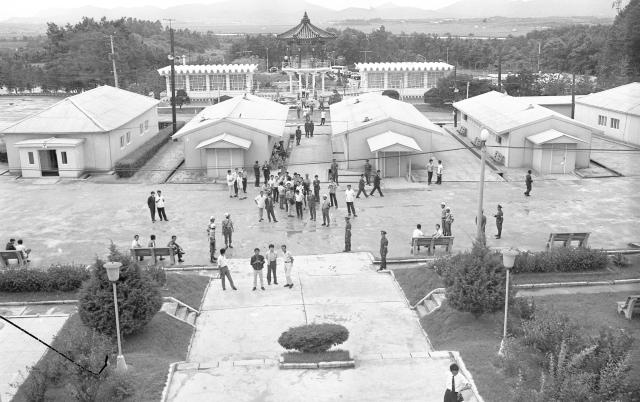 A view looking south from North Korea’s Panmungak in 1973/ Yonhap
 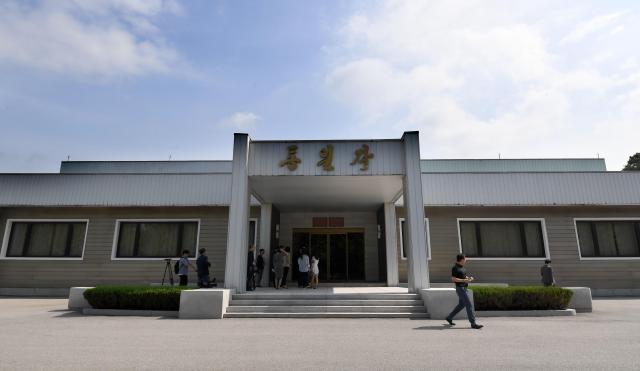 North Korea's Tongilgak pavilion in 2013, which has since been renamed Panmungwan. Yonhap
 Cho Bo-hee 부장 jobo@ajupress.com
![[포토] 폭설에 밤 늦게까지 도로 마비](https://image.ajunews.com/content/image/2025/12/05/20251205000920610800.jpg)
![[포토] 예지원, 전통과 현대가 공존한 화보 공개](https://image.ajunews.com/content/image/2025/10/09/20251009182431778689.jpg)
![[포토]두산 안재석, 관중석 들썩이게 한 끝내기 2루타](https://file.sportsseoul.com/news/cms/2025/08/28/news-p.v1.20250828.1a1c4d0be7434f6b80434dced03368c0_P1.jpg)
![블랙핑크 제니, 매력이 넘쳐! [포토]](https://file.sportsseoul.com/news/cms/2025/09/05/news-p.v1.20250905.c5a971a36b494f9fb24aea8cccf6816f_P1.jpg)
![[작아진 호랑이③] 9위 추락 시 KBO 최초…승리의 여신 떠난 자리, KIA를 덮친 '우승 징크스'](http://www.sportsworldi.com/content/image/2025/09/04/20250904518238.jpg)
![블랙핑크 제니, 최강매력! [포토]](https://file.sportsseoul.com/news/cms/2025/09/05/news-p.v1.20250905.ed1b2684d2d64e359332640e38dac841_P1.jpg)
![[포토] 키스오브라이프 하늘 '완벽한 미모'](http://www.segye.com/content/image/2025/09/05/20250905504457.jpg)
![[포토]첫 타석부터 안타 치는 LG 문성주](https://file.sportsseoul.com/news/cms/2025/09/02/news-p.v1.20250902.8962276ed11c468c90062ee85072fa38_P1.jpg)
![[포토] 국회 예결위 참석하는 김민석 총리](https://cphoto.asiae.co.kr/listimg_link.php?idx=2&no=2025110710410898931_1762479667.jpg)
![[포토] 박지현 '순백의 여신'](http://www.segye.com/content/image/2025/09/05/20250905507414.jpg)
![[포토] 김고은 '단발 여신'](http://www.segye.com/content/image/2025/09/05/20250905507236.jpg)
![[포토] 박지현 '아름다운 미모'](http://www.segye.com/content/image/2025/11/19/20251119519369.jpg)
![[포토] 발표하는 김정수 삼양식품 부회장](https://image.ajunews.com/content/image/2025/11/03/20251103114206916880.jpg)
![[포토] 아이들 소연 '매력적인 눈빛'](http://www.segye.com/content/image/2025/09/12/20250912508492.jpg)
![[포토]끝내기 안타의 기쁨을 만끽하는 두산 안재석](https://file.sportsseoul.com/news/cms/2025/08/28/news-p.v1.20250828.0df70b9fa54d4610990f1b34c08c6a63_P1.jpg)
![[포토] '삼양1963 런칭 쇼케이스'](https://image.ajunews.com/content/image/2025/11/03/20251103114008977281.jpg)
![[포토] 알리익스프레스, 광군제 앞두고 팝업스토어 오픈](https://cphoto.asiae.co.kr/listimg_link.php?idx=2&no=2025110714160199219_1762492560.jpg)
![[포토] 한샘, '플래그십 부산센텀' 리뉴얼 오픈](https://image.ajunews.com/content/image/2025/10/31/20251031142544910604.jpg)
![[포토] 김고은 '상연 생각에 눈물이 흘러'](http://www.segye.com/content/image/2025/09/05/20250905507613.jpg)
![[포토]두산 안재석, 연장 승부를 끝내는 2루타](https://file.sportsseoul.com/news/cms/2025/08/28/news-p.v1.20250828.b12bc405ed464d9db2c3d324c2491a1d_P1.jpg)
![[포토] 언론 현업단체, "시민피해구제 확대 찬성, 권력감시 약화 반대"](https://image.ajunews.com/content/image/2025/09/05/20250905123135571578.jpg)
![[포토] 키스오브라이프 쥴리 '단발 여신'](http://www.segye.com/content/image/2025/09/05/20250905504358.jpg)
![[포토] 아홉 '신나는 컴백 무대'](http://www.segye.com/content/image/2025/11/04/20251104514134.jpg)