 The Cheongun Literary Library/ AJP Yoo Na-hyunSEOUL, January 14 (AJP) - Peter Thiel and Alex Karp, co-founders of Palantir — one of the world’s most prominent artificial intelligence data analytics companies, now valued at more than $426 billion — share an unusual academic background for Silicon Valley: both studied law and philosophy as undergraduates.
 Karp went further. He earned a Ph.D. in classical social theory under renowned German philosopher Jürgen Habermas at Goethe University in Frankfurt, grounding his thinking in traditions that probe the nature of reason, power and social systems.
The renewed attention to philosophy in tech circles reflects a broader question facing the AI era. Philosophy, long focused on the human mind and modes of reasoning once thought exclusive to humans, is increasingly invoked as AI systems grow capable of mimicking — and sometimes surpassing — human cognitive tasks. As AI spreads rapidly from classrooms to workplaces, concerns over ethics, values and human agency have moved to the foreground.
That shift is visible inside AI companies themselves. Amanda Askell, who holds a Ph.D. in philosophy from New York University, works as an in-house philosopher at Anthropic.
Appearing recently on CBS’s 60 Minutes, she answered host Anderson Cooper’s question — “What is somebody with a PhD in philosophy doing working at a tech company?” — by saying, “I spend a lot of time trying to teach the models to be good, and trying to teach them ethics, and to have good character.”
Philosophy’s surprise resurgence in Korea
Against this backdrop, philosophy — long regarded as an impractical or declining field — has seen a surge in popularity at some South Korean universities, where AI adoption is among the fastest in the world.
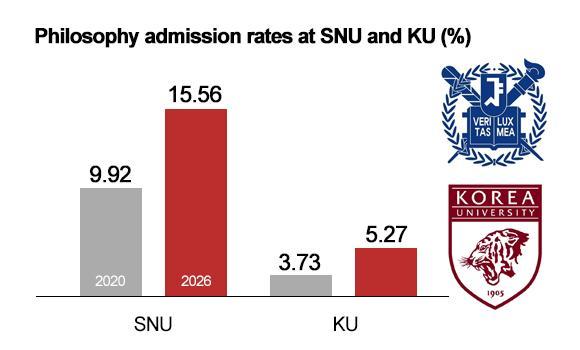
At Seoul National University, the early-admission competition rate for the philosophy department rose from 9.92-to-1 in the 2020 academic year to 15.56-to-1 in 2026. Over the same period, linguistics climbed from 6.9-to-1 to 9-to-1, aesthetics from 7.2-to-1 to 12.56-to-1, and religious studies from 6.7-to-1 to 15.33-to-1.
At Korea University, regular-admission competition for philosophy increased from 3.73-to-1 in 2020 to 5.27-to-1 in 2026, while linguistics rose from 4.57-to-1 to 6.5-to-1.
 Graphics by AJP Song Ji-yoonAt Kyungpook National University in Daegu, the philosophy department recorded a 15.6-to-1 competition rate for regular admissions in 2026 — the highest among all departments.
 Some analysts attribute the trend partly to tech companies showing greater openness to hiring graduates from disciplines such as philosophy and linguistics, valuing skills related to reasoning, language and abstraction.
Baek Do-hyung, a philosophy professor at Soongsil University, said the AI era is reshaping how students view career risk.
“Unlike when the internet or smartphones first emerged, students aspiring to become IT developers may now worry about job security,” Baek said. “Education increasingly requires the ability to think beyond memorizing established knowledge, which makes philosophical training more relevant.”
He added that the AI transition “could become an opportunity to reverse the neoliberal trend that has marginalized foundational disciplines like philosophy within universities.”
Moon Sung-hoon, a philosophy professor at Seoul Women’s University, framed the issue more fundamentally.
“With the universal adoption of artificial intelligence, we are entering a society where machines use machines — something unprecedented,” Moon said. “This inevitably raises basic questions: What does it mean to be human? What are the signs of humanity? How should people live, and how should society be organized if AI replaces human activity?”
Skepticism remains
Still, not everyone agrees that philosophy’s rising admissions numbers reflect a genuine AI-driven revival.
Some scholars argue the connection is overstated, noting that philosophy has long been a popular major among students preparing for law school, where logical reasoning and analytical writing are heavily tested.
Kim Joon-sung, a professor in the Department of Youth Education and Leadership at Myongji University, called recent media coverage “somewhat exaggerated.”
“In reality, philosophy departments have been closing at many universities for a long time,” Kim said.
Kim, who taught in Myongji University’s philosophy department until 2024, now works in another department after the university stopped recruiting new philosophy majors in 2025.
“Even though the department had high enrollment and solid employment outcomes, it was still abolished,” he said.
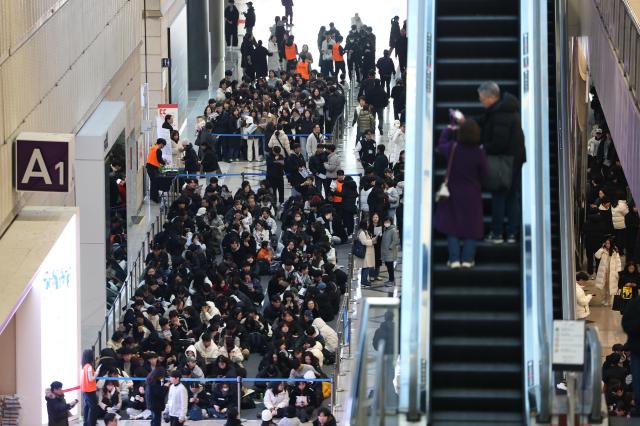 Citizens visiting the university information fair held at COEX in Gangnam-gu, Seoul, on Dec. 18, 2025, stand in line to enter. YonhapOther universities have followed similar paths. Wonkwang University closed its philosophy department in 2022. Kyungnam University halted new admissions in 2014 and shut the department entirely after its final students graduated in 2021. Daejin University merged philosophy with history in 2016, while Hannam University replaced its philosophy department with a philosophy counseling program in 2014.
 Kim argued that the recent surge in applicants at elite institutions such as Seoul National and Korea University “appears to be driven more by law school preparation than by a structural link between philosophy and artificial intelligence.”
For now, philosophy’s renewed visibility in the AI era may reflect aspiration as much as reality — a sign of changing anxieties about technology, rather than a clear transformation in how universities or labor markets value the discipline.
Lee Jung-woo Reporter cannes2030@ajupress.com
![[포토] 폭설에 밤 늦게까지 도로 마비](https://image.ajunews.com/content/image/2025/12/05/20251205000920610800.jpg)
![[포토] 국회 예결위 참석하는 김민석 총리](https://cphoto.asiae.co.kr/listimg_link.php?idx=2&no=2025110710410898931_1762479667.jpg)

![[포토] 예지원, 전통과 현대가 공존한 화보 공개](https://image.ajunews.com/content/image/2025/10/09/20251009182431778689.jpg)
![[포토] 알리익스프레스, 광군제 앞두고 팝업스토어 오픈](https://cphoto.asiae.co.kr/listimg_link.php?idx=2&no=2025110714160199219_1762492560.jpg)
![[포토]두산 안재석, 관중석 들썩이게 한 끝내기 2루타](https://file.sportsseoul.com/news/cms/2025/08/28/news-p.v1.20250828.1a1c4d0be7434f6b80434dced03368c0_P1.jpg)
![[작아진 호랑이③] 9위 추락 시 KBO 최초…승리의 여신 떠난 자리, KIA를 덮친 '우승 징크스'](http://www.sportsworldi.com/content/image/2025/09/04/20250904518238.jpg)
![블랙핑크 제니, 최강매력! [포토]](https://file.sportsseoul.com/news/cms/2025/09/05/news-p.v1.20250905.ed1b2684d2d64e359332640e38dac841_P1.jpg)
![[포토]첫 타석부터 안타 치는 LG 문성주](https://file.sportsseoul.com/news/cms/2025/09/02/news-p.v1.20250902.8962276ed11c468c90062ee85072fa38_P1.jpg)
![[포토] 아홉 '신나는 컴백 무대'](http://www.segye.com/content/image/2025/11/04/20251104514134.jpg)
![블랙핑크 제니, 매력이 넘쳐! [포토]](https://file.sportsseoul.com/news/cms/2025/09/05/news-p.v1.20250905.c5a971a36b494f9fb24aea8cccf6816f_P1.jpg)
![[포토] 박지현 '아름다운 미모'](http://www.segye.com/content/image/2025/11/19/20251119519369.jpg)
![[포토] 키스오브라이프 하늘 '완벽한 미모'](http://www.segye.com/content/image/2025/09/05/20250905504457.jpg)

![[포토] 박지현 '순백의 여신'](http://www.segye.com/content/image/2025/09/05/20250905507414.jpg)
![[포토] 김고은 '단발 여신'](http://www.segye.com/content/image/2025/09/05/20250905507236.jpg)
![[포토] 발표하는 김정수 삼양식품 부회장](https://image.ajunews.com/content/image/2025/11/03/20251103114206916880.jpg)
![[포토] 언론 현업단체, "시민피해구제 확대 찬성, 권력감시 약화 반대"](https://image.ajunews.com/content/image/2025/09/05/20250905123135571578.jpg)
![[포토] '삼양1963 런칭 쇼케이스'](https://image.ajunews.com/content/image/2025/11/03/20251103114008977281.jpg)
![[포토] 한샘, '플래그십 부산센텀' 리뉴얼 오픈](https://image.ajunews.com/content/image/2025/10/31/20251031142544910604.jpg)

![[포토]끝내기 안타의 기쁨을 만끽하는 두산 안재석](https://file.sportsseoul.com/news/cms/2025/08/28/news-p.v1.20250828.0df70b9fa54d4610990f1b34c08c6a63_P1.jpg)
![[포토] 김고은 '상연 생각에 눈물이 흘러'](http://www.segye.com/content/image/2025/09/05/20250905507613.jpg)
![[포토] 아이들 소연 '매력적인 눈빛'](http://www.segye.com/content/image/2025/09/12/20250912508492.jpg)
![[포토]두산 안재석, 연장 승부를 끝내는 2루타](https://file.sportsseoul.com/news/cms/2025/08/28/news-p.v1.20250828.b12bc405ed464d9db2c3d324c2491a1d_P1.jpg)
![[포토] 키스오브라이프 쥴리 '단발 여신'](http://www.segye.com/content/image/2025/09/05/20250905504358.jpg)