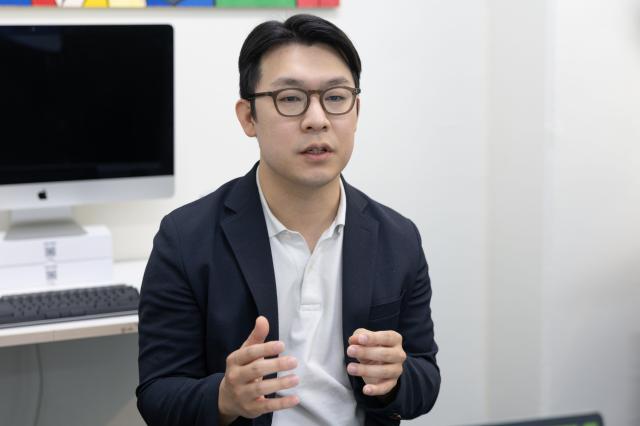
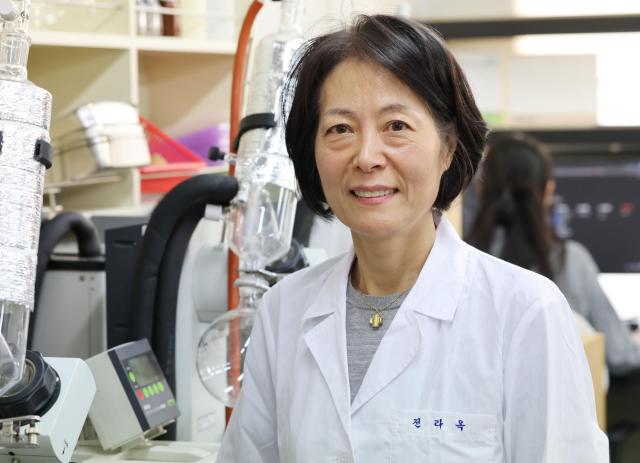
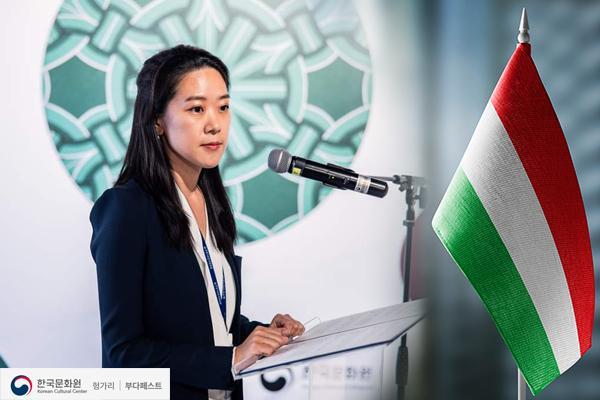
 Director of the Korean Cultural Center in Hungary, Yu Hye-ryeong. Graphics by AJP Song Ji-yoon
 SEOUL, October 21 (AJP) - One in every 200 Hungarians has joined a Korean cultural program in recent years — a sign that Budapest has become the beating heart of the Korean Wave in Central Europe, according to the head of the Korean Cultural Center in Budapest.
"In the past three years, more than 51,000 people have taken part in the center’s programs — an impressive figure in a country of only 9.6 million, meaning roughly one in every 200 Hungarians has joined a Korean cultural activity," said Yu Hye-ryeong, director of the center, in an interview with AJP.
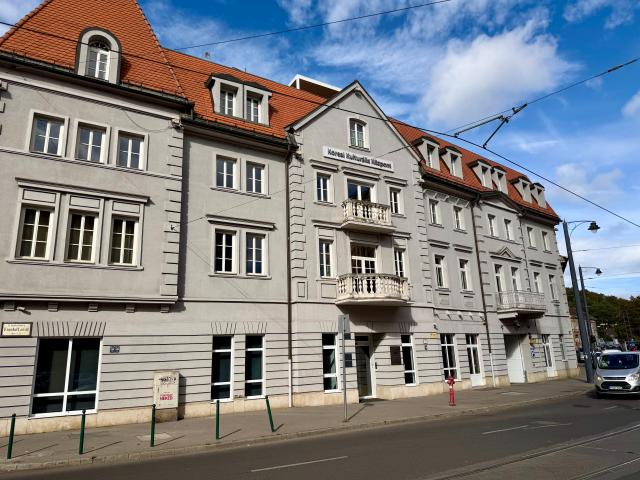 The Korean Cultural Center in Hungary is seen in downtown Budapest, October 2025. AJP Im Yoon-seo
Opened in 2012, the Korean Cultural Center in Budapest has become a key bridge linking Central Europeans with Korean pop culture, language, cuisine, and traditional arts. Since her appointment last year, Yu has reorganized the center’s programs and expanded partnerships with Hungarian institutions to meet the surging demand.
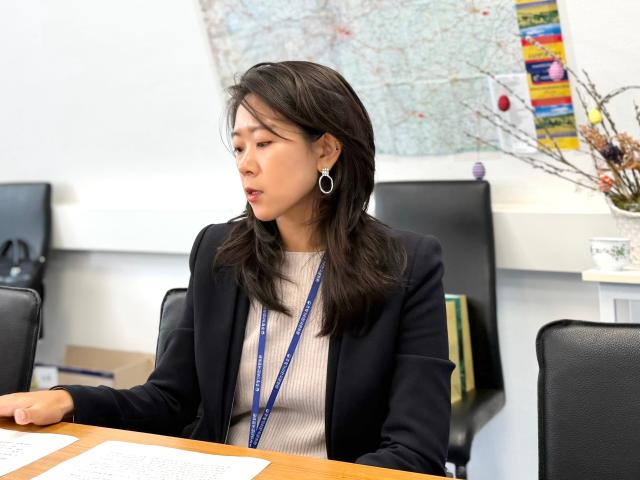 Director of the Korean Cultural Center in Hungary Yu Hye-ryeong speaks during an interview in Budapest, October 2025. AJP Im Yoon-seo
"Participation in our programs has increased sharply," Yu said. "Official data show the number of classes has risen nearly 20 percent — from 1,815 in 2022 to 1,960 in 2023, and 1,928 in 2024 — while total participants jumped 22 percent, from about 15,000 in 2022 and 17,000 in 2023 to more than 18,000 in 2024." She described Budapest as "the heart of Europe," where enthusiasm for Korean culture continues to grow.
According to South Korea’s Ministry of Foreign Affairs, the Budapest center is now the largest of all Korean cultural centers in Europe. Hungarian engagement with Korean culture also ranks among the highest on the continent. Of some 440 active Hallyu fan clubs in Europe, about 130 are based in Hungary — and local media estimate the number has already surpassed 200.
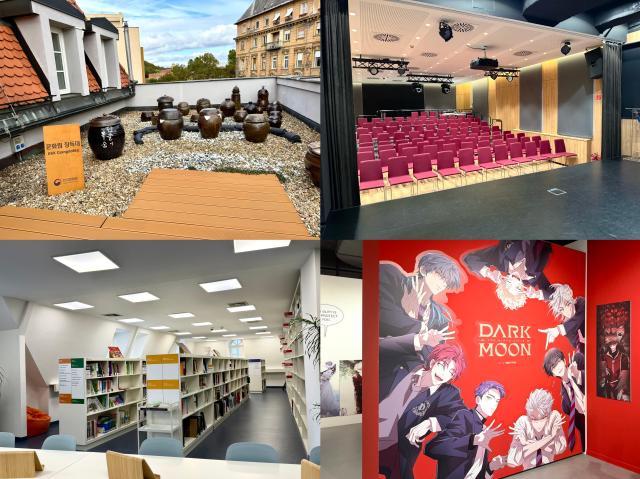 Various areas inside the Korean Cultural Center in Hungary, October 2025. AJP Im Yoon-seo
"Budapest is now the heart of the Korean Wave in Central Europe, and we are striving to contribute even more to this growing movement," Yu said.
She noted that Hungary’s location at the crossroads of Europe — a hub for transport and logistics and home to 200 to 300 Korean companies — amplifies its role as a cultural and economic connector. "The popularity of Korean culture here is linked to Hungary’s geographical advantage and growing cooperation with Korean firms and government agencies," she added.
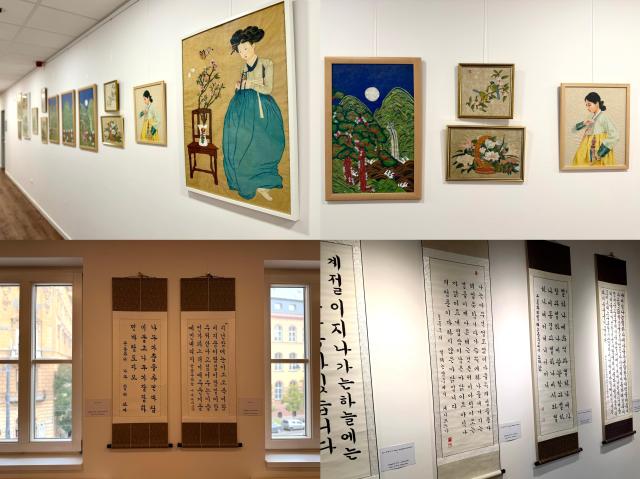 Calligraphy and artworks created by participants of the Korean Cultural Center in Hungary are displayed at the center in Budapest, October 2025. AJP Im Yoon-seo
Yu traced the start of the Korean Wave in Hungary back to the early 2000s, when the historical drama "Dae Jang Geum" (Jewel in the Palace) became the first Korean series broadcast in Europe. "It sparked a wave of curiosity about Korean culture," she said. "For a nation of fewer than 10 million, Hungary’s engagement with Korea is extraordinary — and much of that energy flows through our center today."
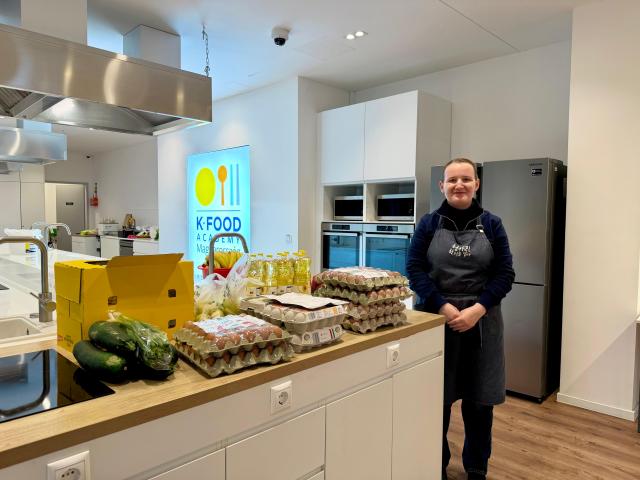 Korean cooking class instructor Toth Krisztina prepares for a class at the Korean Cultural Center in Budapest, October 2025. AJP Im Yoon-seo
The center offers a wide range of classes — from Korean language and calligraphy to folk painting and temple cuisine, a traditional vegetarian style emphasizing natural balance. "Our cooking classes are especially popular and fill up within minutes," Yu said. "Dishes like kimchi sandwiches and gochujang steak are now common in local restaurants, showing how naturally Korean flavors have blended into everyday life."
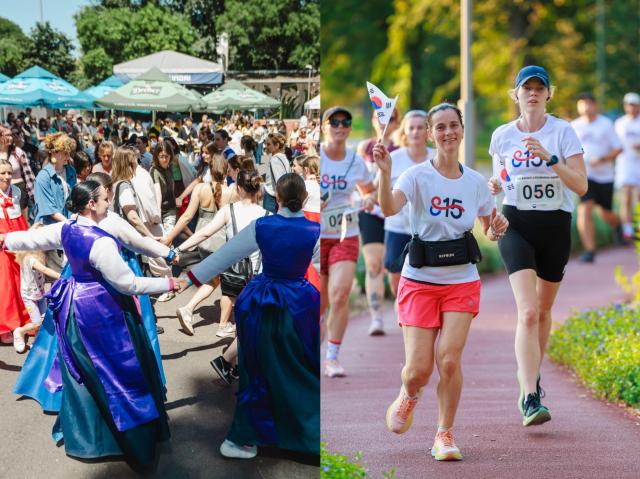 Participants are seen at the KoreaON festival (left) and the marathon marking the 80th anniversary of Korea's liberation (right). Courtesy of the Korean Cultural Center in Hungary
The center also hosts numerous public events and festivals throughout the year. The annual KoreaON festival, now Central Europe’s largest Korean cultural event, drew more than 11,000 visitors in its sixth edition, covered by over 90 Hungarian media outlets. "The festival showcases the full spectrum of Korean culture — from traditional dance and folk music to K-pop concerts," Yu said. "Our live cooking shows featuring Korea’s traditional fermented sauces, known as jang — soy sauce, soybean paste, and chili paste — received particularly enthusiastic responses."
She recalled one highlight: a performance by the K-pop Singers, a Hungarian choir trained by Kim Young-woo of Korea’s renowned vocal group Sweet Sorrow. "The audience stood and sang along — it was unforgettable," she said.
This year’s events marking the 80th anniversary of Korea’s liberation also drew wide attention. One of the highlights was a commemorative run held in Budapest’s City Park on August 15, Korea’s Liberation Day, where participants carried Korean flags to celebrate freedom and unity. A piano concert by Korean artist Chin Soo-young, themed around independence and peace, sold out every seat.
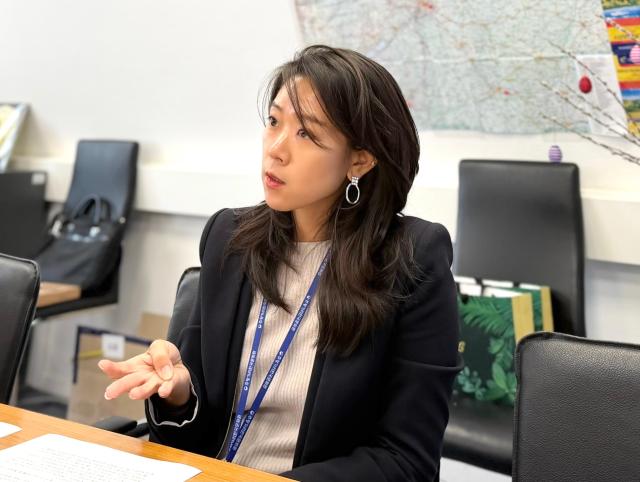 Director of the Korean Cultural Center in Hungary Yu Hye-ryeong answers questions during an interview in Budapest, October 2025. AJP Im Yoon-seo
Looking ahead, Yu said the center plans to deepen its reach across Central Europe. "From the heart of the continent, we’ll continue to fulfill our mission — promoting Korean culture, building mutual understanding, and expanding Korea’s cultural presence throughout Europe," she said.
Im Yoon-seo 기자 lyseo0330@ajupress.com
![[포토] 폭설에 밤 늦게까지 도로 마비](https://image.ajunews.com/content/image/2025/12/05/20251205000920610800.jpg)

![[포토] 국회 예결위 참석하는 김민석 총리](https://cphoto.asiae.co.kr/listimg_link.php?idx=2&no=2025110710410898931_1762479667.jpg)
![[포토] 알리익스프레스, 광군제 앞두고 팝업스토어 오픈](https://cphoto.asiae.co.kr/listimg_link.php?idx=2&no=2025110714160199219_1762492560.jpg)
![[포토] 예지원, 전통과 현대가 공존한 화보 공개](https://image.ajunews.com/content/image/2025/10/09/20251009182431778689.jpg)

![[포토]두산 안재석, 관중석 들썩이게 한 끝내기 2루타](https://file.sportsseoul.com/news/cms/2025/08/28/news-p.v1.20250828.1a1c4d0be7434f6b80434dced03368c0_P1.jpg)

![[작아진 호랑이③] 9위 추락 시 KBO 최초…승리의 여신 떠난 자리, KIA를 덮친 '우승 징크스'](http://www.sportsworldi.com/content/image/2025/09/04/20250904518238.jpg)
![블랙핑크 제니, 최강매력! [포토]](https://file.sportsseoul.com/news/cms/2025/09/05/news-p.v1.20250905.ed1b2684d2d64e359332640e38dac841_P1.jpg)
![[포토]첫 타석부터 안타 치는 LG 문성주](https://file.sportsseoul.com/news/cms/2025/09/02/news-p.v1.20250902.8962276ed11c468c90062ee85072fa38_P1.jpg)
![[포토] 아홉 '신나는 컴백 무대'](http://www.segye.com/content/image/2025/11/04/20251104514134.jpg)
![블랙핑크 제니, 매력이 넘쳐! [포토]](https://file.sportsseoul.com/news/cms/2025/09/05/news-p.v1.20250905.c5a971a36b494f9fb24aea8cccf6816f_P1.jpg)
![[포토] 박지현 '아름다운 미모'](http://www.segye.com/content/image/2025/11/19/20251119519369.jpg)
![[포토] 김고은 '단발 여신'](http://www.segye.com/content/image/2025/09/05/20250905507236.jpg)
![[포토] 박지현 '순백의 여신'](http://www.segye.com/content/image/2025/09/05/20250905507414.jpg)
![[포토] 키스오브라이프 하늘 '완벽한 미모'](http://www.segye.com/content/image/2025/09/05/20250905504457.jpg)
![[포토] 언론 현업단체, "시민피해구제 확대 찬성, 권력감시 약화 반대"](https://image.ajunews.com/content/image/2025/09/05/20250905123135571578.jpg)
![[포토] 발표하는 김정수 삼양식품 부회장](https://image.ajunews.com/content/image/2025/11/03/20251103114206916880.jpg)
![[포토] '삼양1963 런칭 쇼케이스'](https://image.ajunews.com/content/image/2025/11/03/20251103114008977281.jpg)
![[포토] 한샘, '플래그십 부산센텀' 리뉴얼 오픈](https://image.ajunews.com/content/image/2025/10/31/20251031142544910604.jpg)
![[포토]끝내기 안타의 기쁨을 만끽하는 두산 안재석](https://file.sportsseoul.com/news/cms/2025/08/28/news-p.v1.20250828.0df70b9fa54d4610990f1b34c08c6a63_P1.jpg)
![[포토] 김고은 '상연 생각에 눈물이 흘러'](http://www.segye.com/content/image/2025/09/05/20250905507613.jpg)
![[포토] 아이들 소연 '매력적인 눈빛'](http://www.segye.com/content/image/2025/09/12/20250912508492.jpg)
![[포토]두산 안재석, 연장 승부를 끝내는 2루타](https://file.sportsseoul.com/news/cms/2025/08/28/news-p.v1.20250828.b12bc405ed464d9db2c3d324c2491a1d_P1.jpg)
![[포토] 키스오브라이프 쥴리 '단발 여신'](http://www.segye.com/content/image/2025/09/05/20250905504358.jpg)