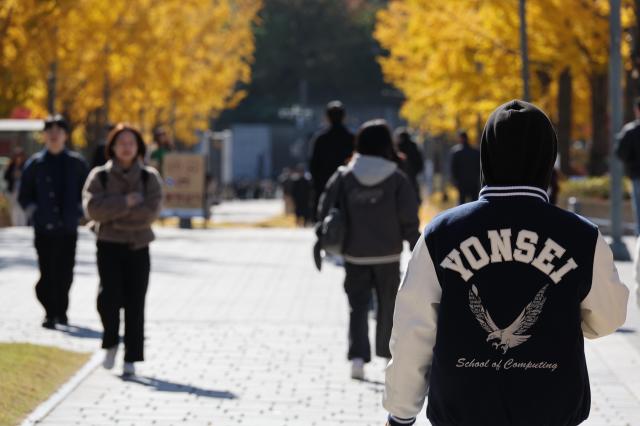
 Students walk along the main pathway at Yonsei University's Sinchon campus in Seoul on Nov. 10, 2025. AJP Yoo Na-hyun
 SEOUL, November 10 (AJP) - ChatGPT has invaded university classrooms and come to test the ethical integrity of students in Korea, as shown by a large-scale exam cheating scandal at elite Yonsei University in Seoul. The case may be only the tip of the iceberg, with 70 percent of Korean universities still lacking any rules or guidelines on AI use.
The issue surfaced when a professor teaching the third-year course "Natural Language Processing (NLP) and ChatGPT" at Yonsei's Sinchon campus revealed that "multiple instances of academic dishonesty have been discovered." The professor urged students to voluntarily come forward to avoid punishment beyond receiving zero points for the midterm, warning that dishonesty could result in disciplinary suspension.
The course, with roughly 600 students enrolled, was conducted entirely online. The midterm in mid-October consisted of multiple-choice questions through an online platform. Students were instructed to record their screens, hands, and faces during the exam, but many allegedly changed their camera angles or opened extra browser windows to covertly access AI tools.
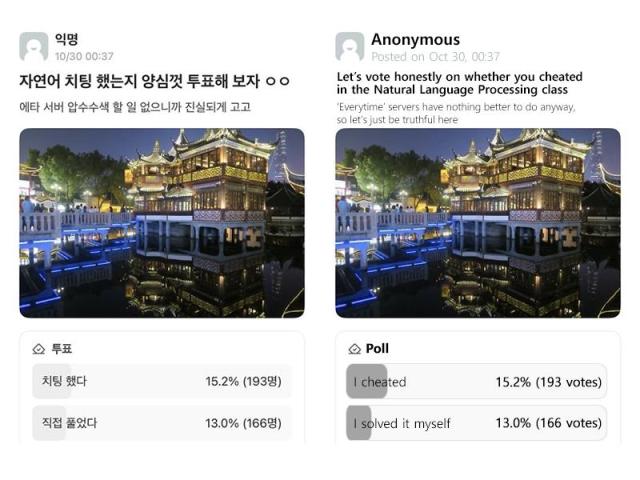 A screenshot of a post on Yonsei University's student community app Everytime, where students anonymously voted on whether they had cheated during the "Natural Language Processing" midterm exam (left), and its English-translated version (right). Screen capture from Everytime / Graphics by AJP Song Ji-yoon
 Within the student community, speculation grew that more than half of the class may have cheated. On Everytime, a popular university community app, an anonymous poll of enrolled students found that 190 out of 359 respondents — about 53 percent — admitted to using unauthorized tools during the test.
"It's ironic that a cheating scandal broke out in a course on AI," said Yoo Eun-seo, 22, a theology major at Yonsei. "It's regrettable that students used AI during a restricted exam, but universities should start designing learning systems that integrate AI rather than banning it. Coexistence with AI is inevitable."
Another student, Cho Je-yi, 21, said she was "shocked" that cheating occurred even with video monitoring. "It seems this wasn't the first time students gained grades through dishonest means," she said. "When more than half your classmates use AI, not using it starts to feel like a disadvantage. Ethical standards clearly need to be redefined."
Cho also noted that distinguishing human-written and AI-generated text has become increasingly difficult. "Tools like Copykiller now have a 'GPT-Killer' function to detect AI content, but many students get flagged unfairly. I've had my own work marked as 'AI-like.' The criteria are vague, and since it's practically impossible to tell the difference, banning AI outright is unrealistic."
Three years after generative AI became mainstream, many universities still lack a coherent strategy. A survey by the Korean Council for University Education (KCUE) found that 71.1 percent of 131 universities nationwide have no official guidelines on generative AI.
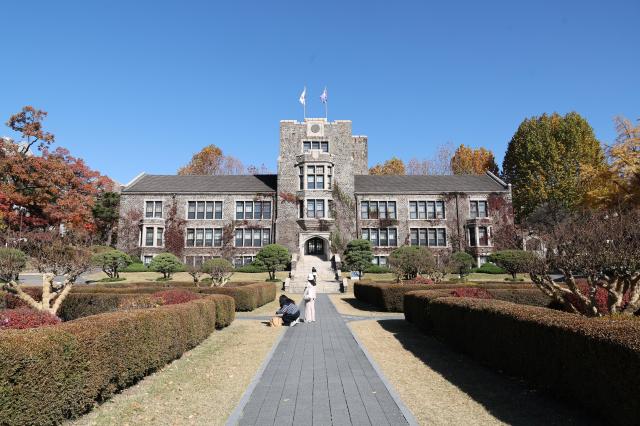 Underwood Hall, one of the oldest buildings at Yonsei University's Sinchon campus in Seoul, is seen on Nov. 10, 2025. AJP Yoo Na-hyun
 By contrast, a 2024 study by Wang, Dang, Wu, and Mac — cited in a KCUE report — found that among the top 100 U.S. universities, 67.4 percent have issued guidelines for faculty regarding AI use, but just 17.8 percent have established rules for students. Only 14.7 percent have institution-wide policies.
Several education systems abroad have moved aggressively. The New York City Department of Education banned access to ChatGPT across public schools in early 2024, and Seattle schools also imposed restrictions. The University of Oxford, the University of Cambridge, Imperial College London, and Sciences Po in France have prohibited the use of ChatGPT in coursework. Universities in Australia have redesigned exams to prevent students from relying on AI-generated answers.
Park Han-woo, professor of media and communication at Yeungnam University and chair of the Korea organizing committee for Internet Research 15 (IR15), said the online format of the exam made it highly likely for students to rely on AI tools.
"The issue is not that students used AI," he said. "We need to talk about responsible and ethical use of AI, because banning it altogether isn't realistic."
Park said Korean universities must develop new teaching and evaluation models suited for the AI era.
Kim Hee-su, Yoo Na-hyun Reporter khs@ajupress.com
![[포토] 예지원, 전통과 현대가 공존한 화보 공개](https://image.ajunews.com/content/image/2025/10/09/20251009182431778689.jpg)
![블랙핑크 제니, 최강매력! [포토]](https://file.sportsseoul.com/news/cms/2025/09/05/news-p.v1.20250905.ed1b2684d2d64e359332640e38dac841_P1.jpg)
![[포토] 발표하는 김정수 삼양식품 부회장](https://image.ajunews.com/content/image/2025/11/03/20251103114206916880.jpg)
![[포토]두산 안재석, 관중석 들썩이게 한 끝내기 2루타](https://file.sportsseoul.com/news/cms/2025/08/28/news-p.v1.20250828.1a1c4d0be7434f6b80434dced03368c0_P1.jpg)
![블랙핑크 제니, 매력이 넘쳐! [포토]](https://file.sportsseoul.com/news/cms/2025/09/05/news-p.v1.20250905.c5a971a36b494f9fb24aea8cccf6816f_P1.jpg)
![[포토] '삼양1963 런칭 쇼케이스'](https://image.ajunews.com/content/image/2025/11/03/20251103114008977281.jpg)
![[포토] 박지현 '순백의 여신'](http://www.segye.com/content/image/2025/09/05/20250905507414.jpg)
![[포토] 키스오브라이프 하늘 '완벽한 미모'](http://www.segye.com/content/image/2025/09/05/20250905504457.jpg)
![[포토] 아이들 소연 '매력적인 눈빛'](http://www.segye.com/content/image/2025/09/12/20250912508492.jpg)
![[포토] 국회 예결위 참석하는 김민석 총리](https://cphoto.asiae.co.kr/listimg_link.php?idx=2&no=2025110710410898931_1762479667.jpg)
![[포토] 박지현 '아름다운 미모'](http://www.segye.com/content/image/2025/11/19/20251119519369.jpg)
![[포토] 김고은 '단발 여신'](http://www.segye.com/content/image/2025/09/05/20250905507236.jpg)
![[작아진 호랑이③] 9위 추락 시 KBO 최초…승리의 여신 떠난 자리, KIA를 덮친 '우승 징크스'](http://www.sportsworldi.com/content/image/2025/09/04/20250904518238.jpg)
![[포토]첫 타석부터 안타 치는 LG 문성주](https://file.sportsseoul.com/news/cms/2025/09/02/news-p.v1.20250902.8962276ed11c468c90062ee85072fa38_P1.jpg)

![[포토] 알리익스프레스, 광군제 앞두고 팝업스토어 오픈](https://cphoto.asiae.co.kr/listimg_link.php?idx=2&no=2025110714160199219_1762492560.jpg)
![[포토] 키스오브라이프 쥴리 '단발 여신'](http://www.segye.com/content/image/2025/09/05/20250905504358.jpg)
![[포토]끝내기 안타의 기쁨을 만끽하는 두산 안재석](https://file.sportsseoul.com/news/cms/2025/08/28/news-p.v1.20250828.0df70b9fa54d4610990f1b34c08c6a63_P1.jpg)
![[포토] 한샘, '플래그십 부산센텀' 리뉴얼 오픈](https://image.ajunews.com/content/image/2025/10/31/20251031142544910604.jpg)
![[포토] 언론 현업단체, "시민피해구제 확대 찬성, 권력감시 약화 반대"](https://image.ajunews.com/content/image/2025/09/05/20250905123135571578.jpg)
![[포토] 김고은 '상연 생각에 눈물이 흘러'](http://www.segye.com/content/image/2025/09/05/20250905507613.jpg)
![[포토]두산 안재석, 연장 승부를 끝내는 2루타](https://file.sportsseoul.com/news/cms/2025/08/28/news-p.v1.20250828.b12bc405ed464d9db2c3d324c2491a1d_P1.jpg)
![[포토] 아홉 '신나는 컴백 무대'](http://www.segye.com/content/image/2025/11/04/20251104514134.jpg)
![[포토] TXT 범규 '반가운 손인사'](http://www.segye.com/content/image/2025/11/05/20251105518398.jpg)